


Fifth International Teacher Educator Conference 2015
Tushar garg, Published On:27-Feb-2015
Governor’s speech:
It is an honour for the city of Hyderabad that this conference has been held here since 2011. From the very beginning of its journey, successive editions of the Teacher Educators Conference, have brought together practitioners and policy makers in the field of English language teacher education from all over India and the entire South Asia region, and many other countries in the world. Starting off in 2011 with 650 speakers and delegates, last year over 110 speakers delivered sessions to over 1,200 delegates from 27 countries.
In keeping with the information and communications technology hub that Hyderabad is, the live webcast of the conference sessions reaches out to teacher educators across India and around the world. There is little doubt that across the world knowledge of English is an asset for young people seeking employment opportunities, as well as being an international language of communication.
In India, a linguistically and culturally diverse nation, with a growing young population, emerging as a global power, as well as India’s historical legacy, the role of English is not without controversy but is surely of great importance to the future of the nation. Without English, it becomes difficult for students to access higher education across a country as vast and diverse as India. Without English it becomes difficult for our youth to gets jobs or access international education, research and career opportunities and aspire for more for themselves and their communities. English teaching, and the education system more generally, faces an enormous challenge with the massive increase in students now enrolled in our schools.
.jpg)
The successes of the past 10 to 15 years in our education system, and they are undoubtedly hugely significant, have led to better access and improved facilities, but issues still exist in better learning outcomes for students. Reports such as the Annual Survey of Education Report (ASER) and the Public Report on Basic Education (PROBE) indicate that whilst more of our young people are going to school, what they learn is often limited, not keeping pace with their aspirations or with the requirements of higher education or employers.
It is now a fact that across India parents, including those who can least afford it, are choosing to put their children in private, mostly unregulated English medium schools as a result. This is certainly linked to the quality of teaching and therefore to the quality of teacher education. In order for our young people to attain higher levels of English proficiency, we need high quality teachers, high quality learning materials and high quality systems in place to ensure teachers receive the training they require.
This conference seeks to address these issues of quality in English language teacher education from these different perspectives. It is important to note that quality in teacher education is not a simple matter of top down policy change, but also a concern of the teaching profession itself. Recent policy initiatives, such as the introduction of a two year BEd programme which focuses more on practical implementation are undoubtedly positive.
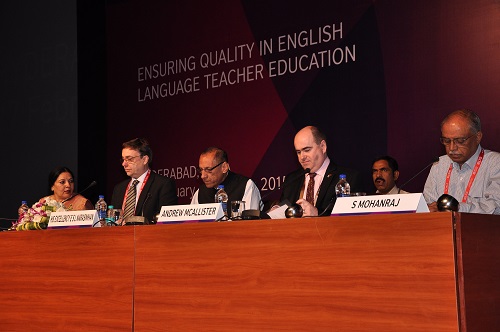
But as the National Curriculum Framework for Teacher Education states we need to look beyond that to in-service teacher training, school -based initiatives, the role of technology in teacher education, and how teachers themselves can take control of their own destiny through self-directed continuing professional development. In the case of English, we need to look at the linguistic proficiency of teachers: how can we help the teachers themselves gain sufficient knowledge of the language to be in a position to reach their learners with the authority that comes from confidence in the language?
It seems to me to be another instance of where technology can help, as teachers, as well as students, have enormous language learning opportunities with access to technology increasing and technology-based learning programmes improving so rapidly. Quality in education is not a concern of India alone. The international commitment to providing Education for All has moved in recent years from a focus on access to one of quality.
A conference such as this helps us to not only share our experiences and best practice in India, but to connect with fellow professionals from around the world. I am particularly pleased to hear that we have a large representation of delegates from the SAARC region, as so many of the countries in south Asia have similar issues.
This conference is jointly hosted by the British Council and the English and Foreign Languages University, Hyderabad and I thank them for organising this event. I look forward to hearing your recommendations which emerge from the conference and I hope that you have a productive few days.